Failing Our Veterans by Mark Boulton
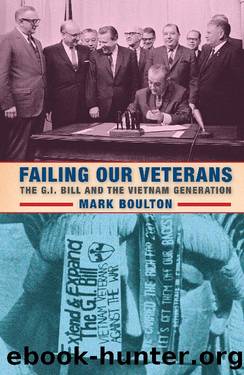
Author:Mark Boulton [Boulton, Mark]
Language: eng
Format: epub
Publisher: NYU Press
Published: 2014-06-15T04:00:00+00:00
Olin Teague (center) relaxing with his personal friend and commander of U.S. military operations in Vietnam from 1964 to 1968, General William Westmoreland (right), alongside Richard Nixon (left). Teague frequently worked in unison with the president to reduce federal spending, including veterans’ benefits. Courtesy of the Cushing Memorial Library and Archives, Texas A&M University.
As President I have done everything I can to see to it that this gratitude and respect is reflected by the Government’s treatment of American veterans. Dollars, health care, educational opportunities can never fully repay the sacrifices our veterans have made, but they can at least serve as a beginning. I am happy to be able to report that America is doing more for its veterans today than ever before.
Failing to mention his own continued opposition to higher benefits and the slashing of VA funds for medical care, he boasted that “we” had raised education benefits, increased hospital treatments by four million patients, and doubled the number of participants in the G.I. Bill program.69 Continuing to fawn over the soldiers in public, Nixon invited eighty Vietnam veterans to the signing ceremony in the White House State Dining Room. They had been carefully selected for their support of Nixon’s Vietnam policies, so that the president could be seen standing tall with “the real heroes of America, the ones who have chosen to serve rather than run away.”70 Nixon informed them that the bill “will allow you to get that education and that training so essential to get the jobs that you will later want.”71 The Vietnam Era Veterans’ Readjustment Assistance Act of 1972 became Public Law 92-540 on October 24, 1972.
Thereafter, and as with many previous White House occupants, Nixon continued his pattern of working behind the scenes to cut veteran funding in many areas while lauding the veterans in public. In March of 1973, in a “Statement About the Vietnam Veteran,” Nixon proclaimed, “No group of American fighting men was ever called on to demonstrate their bravery, their endurance, or their love of country under more trying circumstances than those gallant Americans who served in Vietnam.” Promising to “honor them,” he went on to claim that no other generation of veterans had ever enjoyed such a wide range of government benefits. He then called on all employers to look favorably upon Vietnam veterans in their hiring practices.72 But he also used one of his favorite tactics to undermine one of the education programs he had signed into law the previous October. Upsetting the constitutional balance, Nixon regularly impounded money appropriated by Congress for federal programs, effectively killing the program. He did this on over one hundred occasions, most notably for the Clean Water Act of 1972.73 He refused to release $25 million for the Veterans’ Cost of Instruction Program, authorized under the 1972 G.I. Bill, designed to give money to institutions that encouraged veteran enrollment. It took court proceedings brought by the National Association of Collegiate Veterans (NACV) to release the money in May of 1973. The
Download
This site does not store any files on its server. We only index and link to content provided by other sites. Please contact the content providers to delete copyright contents if any and email us, we'll remove relevant links or contents immediately.
| Africa | Americas |
| Arctic & Antarctica | Asia |
| Australia & Oceania | Europe |
| Middle East | Russia |
| United States | World |
| Ancient Civilizations | Military |
| Historical Study & Educational Resources |
The Battle of Mogadishu by Matt Eversmann;Dan Schilling(682)
Five Four Whiskey by Robert Sweatmon(484)
Level Zero Heroes by Michael Golembesky(461)
Thirteen Soldiers by John McCain(433)
All the Ways We Kill and Die by Brian Castner(414)
A People's History of the U.S. Military by Michael A. Bellesiles(386)
The Bonus Army by Paul Dickson(353)
A More Unbending Battle by Peter Nelson(334)
Bringing Mulligan Home by Dale Maharidge(317)
Sherman Lead by Gaillard R. Peck Jr(312)
Troop Leader by Bill Bellamy(307)
The Little Lead Soldier by Hugh D. Wise(306)
Invisible Heroes of World War II by Jerry Borrowman(290)
Marching Home by Brian Matthew Jordan(289)
It Shouldn't Be This Hard to Serve Your Country by David Shulkin(285)
I Flew for the Fuhrer by Heinz Knocke(252)
Crosshairs on the Kill Zone by Craig Roberts & Charles W. Sasser(247)
What Was Asked of Us by Trish Wood & Bobby Muller(242)
Barbarossa and the Retreat to Moscow: Recollections of Soviet Fighter Pilots on the Eastern Front (The Red Air Force at War) by Artem Drabkin(234)
